AIRFOIL PRIMER
FOR
NON-AERODYNAMICISTS
JOHN DREESE
&
DREESECODE SOFTWARE LLC
RED HOPE
Copyright ©
2004 by John Dreese
All rights
reserved.
Pages: 30
No part of
this book can be reproduced in any form by any means without the express
permission of the author. This includes reprints, excerpts, photocopying,
recording, or any future means of reproducing text.
Email:
DesignFOIL@gmail.com
Web:
http://www.dreesecode.com/primer/
Twitter:
http://www.twitter.com/JJDreese/
Amazon Kindle
Version available from:
http://www.amazon.com/dp/XXXXXXXX
Version 1.0
Published in the
United States of America.
PREFACE/FIGURE NAMES
This book is
the culmination of a five-part magazine article series that I wrote in 2004. It
is one of the most popular features on the DesignFOIL
website and I’ve been asked to put it in a simple Kindle format for people to
read offline.
Figures: On the website, each part is a
standalone web page and the figure numbers refer to that web page. In
this Kindle book all five web pages are combined – each one is a chapter. The
figure names refer to that particular chapter. So you might see a reference to
Figure 2. It means Figure 2 from –that- chapter.
Regards,
John Dreese
NOTE:
All airfoil shapes and data were
created using DesignFOIL. A free demo is available on
the website at www.dreesecode.com
PART 1:
WING SECTIONS & LIFT
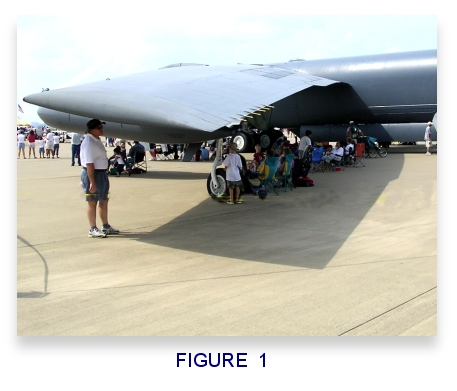
Airshows are a
great place to study airplanes and crowd psychology. We wait patiently in long
lines for hotdogs, bathrooms and overpriced water. Of course, people do that at
all large gatherings, but the one group activity found only at airshows is the creation of
the people-filled
shadows, as
shown in Figure 1.
As the hot Sun
cooks the crowd, they migrate under the protective wing shadows of huge
airplanes, preferably a C-130 or a B-52 bomber; something with a huge wing area. And just like
that, we’ve discovered yet another practical use for airplane wings!
This primer
talks about why we have wings at all. As the aerodynamicist Jack Moran said,
wings are simply a thrust amplifier. Sure, we could use rockets to get from point A to
point B, but that would be incredibly inefficient as far as fuel usage goes.
That’s where wings come in. They provide a similar ability to defy gravity, but
at a fraction of the fuel usage compared to rockets.
Rather than use
directed raw force, wings have a unique characteristic; they generate a force
that is perpendicular to the
direction of movement. Airplanes move horizontally, but wings push up
vertically (LIFT). This magic of
physics is simply a result of how air flows over the wings. This primer series
is about how lift is created, how to estimate it, and how to make it happen.
The origin of
lift is very simple: it is the result of having lower air pressure above the wing
than below it. Air cannot impart direct forces on a wing like a hammer can.
Instead, it can only impart forces via two methods: pressure and friction. Those are the
only two ways. Lift comes from a pressure difference between the upper and
lower wing surfaces. Pretty simple eh?
No doubt, there are
many theories as to what causes the
required pressure difference. That's where people get all bent out of shape.
Blame it on Bernoulli? Blame it on momentum transfer? The devil is in the
details.
Streamlined wings
aren't the only things that can create lift; a sheet of plywood can also generate lots of
lift. Unlike a wing, of course, a sheet of plywood is aerodynamically very
inefficient. The secret to making this pressure-difference miracle more
efficient is to use a cross-sectional shape that won’t cause separation at the
nose. Plywood has a sharp leading edge which generates oodles of DRAG;
that's the retarding force that keeps us from moving forward as fast as
we’d like to. Historically, good wings use cross-sectional shapes that
are round in
the front and sharp in the back. We call this shape an Airfoil (Figure
2). There are parts of the world that use different names like aerofoil and profile.
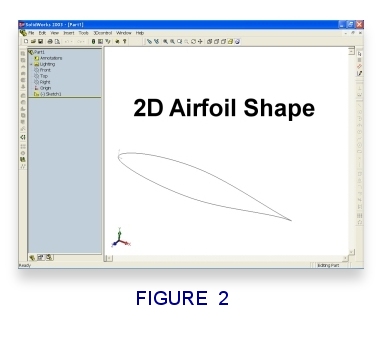
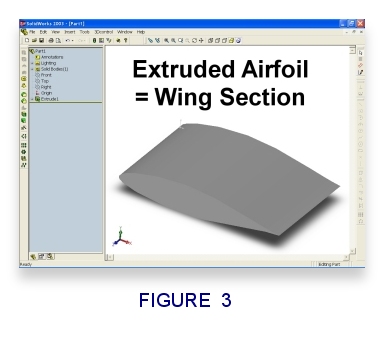
Technically,
airfoils are flat two-dimensional shapes, and can’t produce any lift at all;
great for pictures on paper, but lousy for lift. You have to extrude an airfoil into the 3rd dimension to
create an object that will make lift. We call this extruded shape a wing section (see
Figure 3).
So now you have
a device that generates a pressure difference, resulting in a vertical lift
force and a slight down-deflection of air behind it. Who cares? Millions of
airline passengers care.
Nature will
direct the airflow around a wing section so that the air obeys the conservation
laws of mass & momentum. If the real world physics are obeyed, some of the
oncoming air will go over the wing section and some will go under the wing
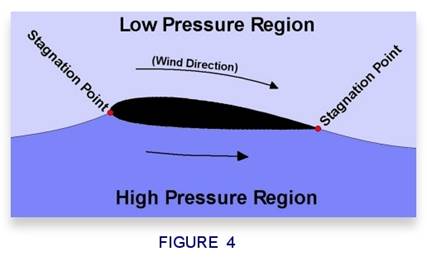
section. The point on the leading edge where the oncoming flow splits is called
the stagnation
point. Strangely
enough, the velocity of air at that very point is zero. There's another
stagnation point at the trailing edge, where these two travelling air masses
come back together. Figure 4 illustrates these stagnation points.
The air pressure
along the upper and lower surfaces can vary wildly. It usually drops lower than
ambient pressure along the upper surface, especially if the wing section is
angled up at all. For a lifting airfoil, the airflow above is typically
accelerated faster than the air below. Think of it as the air up front racing
fill the void of all that air you just pushed down behind the wing. From Bernoulli's famous
effect, we know that when air speeds up, the air pressure drops. The end result
is that the pressure difference between the lower and upper surface
literally sucks
the wing upward!
To conclude the
idea, lift comes from a combined effort of the wing being sucked upwards
and the wing deflecting some of the air downward. The effects are so
intrinsically linked together that we can calculate the lift force by simply
measuring surface pressures around the wing section. That's one method which
wind tunnels use to measure lift forces and pitching moments on a wing section
model. Many advanced wind tunnels use a different technique for drag which
measures how much momentum the model "steals" from the oncoming
airflow via the boundary layer; we'll get into that later.
One
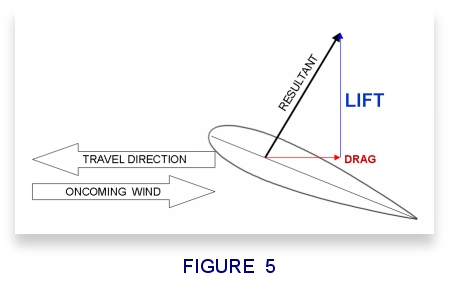
last note about lift. A wing section exposed to an oncoming wind
generates a single united force, usually pointing up vertically and slightly backwards. We call this theResultant force. Lift is the
portion of that force that is perpendicular to the direction of travel, not the
direction the airfoil is pointing. Drag is the
portion that is parallelto the direction of travel. See
Figure 5 for an illustration.
Now you know
where lift comes from. Next time, we'll learn the basic terms regarding airfoil
geometry.
PART 2:
BASIC AIRFOIL GEOMETRY TERMS
Subsonic airfoils
should be round
in the front and sharp in the back. A century of
visual reminders should make this obvious. However, I see it violated often
with regard to after-market wings people install on their cars. The wings are
already not very effective for the speeds that most cars are driven, but they
are -really- ineffective when mounted backwards. Remember: put the round end
upstream and the sharp end downstream. That's really the big rule at the core
of standard airfoil setup. Everything else is just tweaking and
optimization. For our purposes, all airfoil diagrams shown in this primer
series assume air movement from left to right.
Let's look at an
example:
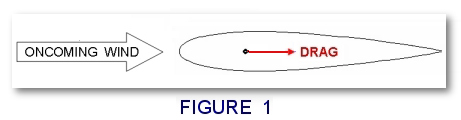
Take a symmetric
airfoil and point it directly into the oncoming wind as shown inFigure 1. Since the
airfoil is parallel with the wind, we can’t measure or feel any perpendicular
forces (up or down in this case). The lift is zero. However, there is a
slight tugging
force from
the friction of air dragging along the airfoil surface. We call this
force drag.
You might wonder
what use could come from a symmetric airfoil oriented parallel to the wind? It makes for a perfect streamlined fairing, a shield that hides some underlying
non-streamlined structure like a wire, antenna, pipe, or landing gear strut.
Streamlining is
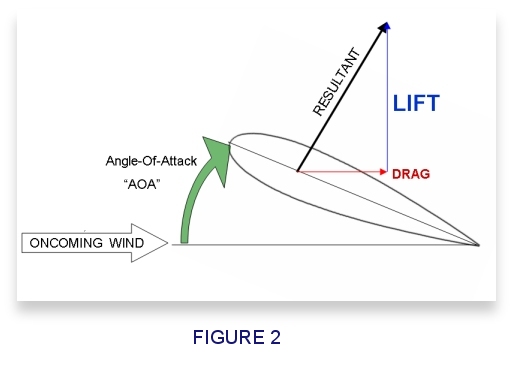
nice, but we want lift. Let’s gently tip the airfoil up to some small angle as
shown inFigure 2. Suddenly,
there is a noticeable force upwards while the dragging force increases
slightly. What you’ve just discovered is that an increase in the angle between
the chordline of the airfoil (an imaginary straight line
stretching between leading edge and trailing edge) and the oncoming wind will
increase the lifting force. This variable angle is called the Angle-Of-Attack, or AOA for short.
What you need to know is that increasing the AOA will increase both the lift
force and the drag
force. This effect will continue up until about 15 degrees. After that, the
lift force will start to fall, but drag will continue to grow. We call this
phenomenon stall. It is the
result of the formerly smooth air over the wing breaking down and separating
from the wing. One special note: if the airfoil has upward bow to the shape (camber), then
increasing the angle-of-attack may actually decrease the drag force for a few
degrees before it resumes its quick climb.
Angle-Of-Attack is the angular
difference between where the wing is pointing and where it is moving. The first
time I truly understood this was when, as a kid, I saw a Boeing jet climbing
very slowly away from Columbus International Airport in Ohio. It appeared to be
just plowing through the air nose-high. The airplane nose will not always point
straight in the direction the airplane is flying, especially during landing and
takeoff.
Figure 3 shows a typical airfoil geometry with the important components
labeled. The Upper
Surface is
the wing section skin on top, from the leading edge to the trailing edge.
The Lower
Surface is
the bottom wing section skin that goes from the leading edge to the trailing
edge. Mentioned already is the chord line, which is an imaginary straight line
between the leading edge and trailing edge; this is used for measuring/setting
Angles-Of-Attack (see Figure 2).
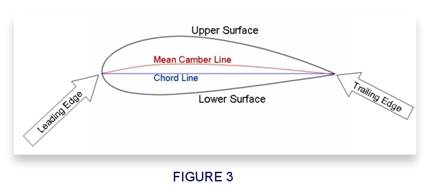
The chord line
should not be confused with the mean camber line, or meanline for short.
The mean camber line is an imaginary line that divides the airfoil into equal
(roughly) upper and lower halves. On a symmetrical airfoil, the mean camber
line is thesame as
the chord line. However, if you bow the airfoil upwards, you are adding
"camber" to the airfoil. A unique characteristic of airfoils with
camber is that they produce lift at zero degrees Angle-Of-Attack. The more
camber, the more lift. Of course, there is an associated cost of more drag and
more pitching moment (we'll get to that later) as well.
A perfect airfoil would
allow you to change the mean camber during flight; providing ample camber for
takeoff and landing, but very little during cruise. Fortunately, there is a
simple method for doing this without resorting to bending or flexing the
structure. Instead, we droop down the aft portion of the wing section using a
hinge. This device is called a flap and temporarily adds camber to the wing
section. Flaps allow our wing section to have lots of camber during takeoff and
very little camber during cruise. If the flaps also extend backwards while they
droop, then they also provide increased wing area, making for an amplified
lifting effect.
In Part 3 of
this primer series, we will discuss lift and drag calculations in more detail.
We will discuss their respective coefficients, which allow us
to compare the performance of different airfoils on a common scale.
HOW MUCH LIFT AND DRAG CAN A WING GENERATE?
Many
smart people asked this same question in the late 1800’s and early 1900’s. They
wanted a simple formula to predict the forces ahead of time. The main
challenge to finding a simple formula was that the lift force was not just a
function of one
thing; it
was a function of many things.
Here's
a summary of information those early pioneers knew about:
- As
the density of air increases, the lift force also increases.
- As
the wing area increases (birds-eye view), the lift force also increases.
- When
airspeed is doubled, the lift force is quadrupled!
With
these trends in mind, those smart engineers and scientists stated that Lift was
proportional to the air density, proportional to the wing area, proportional to
the square of the velocity, and was somehow related to the wing cross-section
itself. But even after they figured all this out, there still wasn’t an exact formula.
For example, they couldn’t say that lift was exactly equal to the
product of speed, density, and wing area. The best they could do was say that lift was sort of equal to that product. Kindof equal.
But not exactly equal to a combination of all those things.
In
this situation, engineers often state a problem in outline form using a
proportionality symbol called tilda, or
"~". Here's a pseudo-equation for Lift:
LIFT ~ DENSITY * SPEED * SPEED * AREA
To
fix this lack of exactness, they did what any good engineers would do; they
used something called a proportionality constant, also sometimes called a coefficient. Generally,
these are special numbers used to make our answers agree with what we measure
in the real world; especially with natural phenomena where many of the lesser
influences are lumped into that single special coefficient. Non-engineers can
think of this as a fudge factor,
but it's a very well thought out fudge factor. You can represent this coefficient
with any letter of your choice; historically for Lift we've used the letter C
with a little "L" as a subscript: Cl
Let's
take another attempt at making a more exact Lift equation:
LIFT = Cl * (0.5) * DENSITY * SPEED * SPEED * AREA
Stop
the presses! You may wonder where the one-half (0.5) came from. That's actually a
result of developing the formula using a more advanced method called dimensional analysis, but I won't dive
into that process right now.
Similar
to the Lift force equation, we can create formulas for the drag force and
pitching moment as well. The only real difference is that the pitching moment
includes the extra factor of chord-length at the end:
DRAG = Cd * (0.5) * DENSITY * SPEED * SPEED * AREA
PITCHING MOMENT = Cm * (0.5) * DENSITY * SPEED * SPEED * AREA *
CHORD
You
can probably see the problem already. The formulas are great and all, but we
still can't use them because we don't know the values of the coefficients (Cm and Cd). This is where
a wind tunnel really helps us. I'll cut to the chase: the coefficients are a
function of the Angle-Of-Attack of your airfoil section.
Fortunately,
our engineering ancestors tested thousands of airfoil sections in wind tunnels and they created
wonderfully useful charts showing how the coefficient values change as a
function of Angle-of-Attack, or AOA.
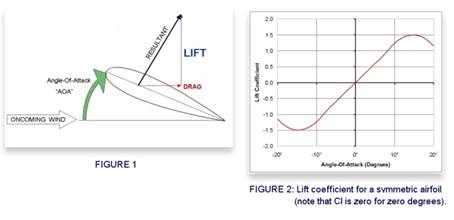
See Figure 1 below for an illustration of this parameter. When given a specific
AOA, we can look at a chart like Figure 2 below for our airfoil to quickly
discern what the coefficients should be.
Coefficients
are helpful for many reasons. First of all, with just a little bit of
performance data on our two-dimensional airfoil, we can extrapolate the
aerodynamic performance of a new and untested wing. Secondly, coefficients also
make it easy to make comparisons between two different airfoils. For example,
if our airplane wing needs a lift coefficient of 0.3 to stay aloft, we can
choose the airfoil that produces theleast amount of drag at that lift coefficient. And
coefficients are fairly robust. You can usually trust that a chart of
coefficients will remain unchanged. Except, of course, for
one small problem. To apply the proper coefficients, we must make sure
that the original data was captured at the same Reynolds Number. We’ll talk
about that soon, but let's elaborate on these coefficients.
ESTIMATING LIFT, DRAG, & PITCHING MOMENT
To
estimate any of these forces or pitching moments (torques), you need to have
real numbers for the coefficient. If we can measure the wing sections'
Angle-of-Attack (See Figure 1 above), then we can quickly look up the coefficients
from charts similar to those shown in Figure 2 above.
LIFT CALCULATION EXAMPLE
Recall
the formula for Lift:
LIFT = Cl * (0.5) * DENSITY * SPEED * SPEED * AREA
Are
these terms confusing? Let me explain them.
As
we just discussed, the Cl term
is called the lift
coefficient.
It is a function of Angle-of-Attack and is generally a
straight line with a slope of
0.11 per degree (AOA). It varies from airfoil to airfoil, but it usually peaks
at an angle of about 15 degrees and starts to drop after that. That drop-off
phenomenon is called STALL.
The important thing to remember is that, unless you’re operating near the stall
region, every one-degree increase in angle-of-attack increases the lift
coefficient by about 0.11.
Of
special note, the 0.11-per-degree slope stays fairly constant until you include
3D effects (wingtips, etc...). We can add flaps, slats, and other doohicky’s to our infinitely-spanned wing section, but the
lift-per-degree slope doesn’t
change. Yes, those additional devices will move the line around the chart, but
they won’t change the slope.
Air density is
measured in something strange called slugs. That’s right; slugs. In the metric
system, mass is measured in Kilograms. In the English system (foot, inches,
pounds, etc…) we use slugs. On the surface of the
earth, one slug weighs about 32.2 pounds. Confusing stuff, right? Just know
that the density of air at sea level is roughly 0.002377
(double-oh-two-three-seven-seven) slugs per cubic foot.
SPEED is
the velocity of flight in feet per second. Not miles per hour.
AREA is
the area of the wing in square feet as seen from a birds-eye view above. We
call this type of area the planform area.
NOW BACK TO THE LIFT EXAMPLE...
Let’s
put an imaginary symmetric wing-section
model in the Ohio State University’s three foot by five foot wind tunnel. It
will span the entire width of the test section (wall to wall); that means the
span will be 3 feet. Our chord length is roughly 2 feet. That gives us a wing
area of about 6
square feet.
Ohio
State University is at an altitude of roughly 900 feet above sea level so the
density today is 0.002315 slugs per cubic foot (I got that from an internet
weather website). We turn on the wind tunnel fan and blow air over the model at
a speed of 100 feet per second. I forgot to tell you that we used the most
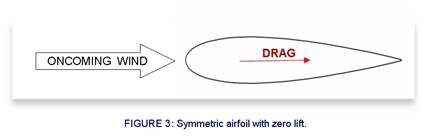
common airfoil ever produced: the NACA 0012 symmetrical airfoil section. We’ve
manually set the Angle-of-Attack to zero degrees as shown in Figure 3. With no
angle-of-attack, Figure 2 shows that our lift coefficient is roughly
zero.
After
plugging those values into the Lift Equation, it looks like this:
LIFT = Cl * (0.5) * DENSITY * SPEED * SPEED * AREA
LIFT = 0.0* (0.5) * 0.002315* 100
* 100 * 6 = 0 pounds
We have no lift. This is expected for a symmetric airfoil at
zero degrees Angle-of-Attack. Your assistant increases the airspeed. Still no
lift, but your load cells have registered an increase in the drag force.
It
looks like we’re going to have to change something other than airspeed to generate
lift out of this wing-section. We can do that! Ask your assistant to turn the
knob that manually tilts the nose of the wing-section upward (i.e. increases
Angle-of-Attack). After some finagling of the equipment, we note that the
wing-section is now rotated upward at 5 degrees Angle-of-Attack similar to the
airfoil in Figure 1. According to the chart in Figure 2, such an
Angle-of-Attack will give us a lift coefficient equal to about 0.55. With that
information and our Lift equation, we can predict that our wing wection will produce a lifting force:
LIFT = Cl * (0.5) * DENSITY *
SPEED * SPEED * AREA
LIFT = 0.55* (0.5) * 0.002315* 100
* 100 * 6 = 38.2 pounds
With
the prediction in hand, we look at the Lift Force Meter on the wind tunnel and
we note a reading of about 38 pounds. Success! Using previously obtained
aerodynamic data, we were able to predict and reproduce the lift force
experienced by our wing-section model inside a wind tunnel.
DRAG CALCULATION EXAMPLE
Just
for fun, let’s continue increasing our Angle-of-Attack. The lift force will
continue to increase until we reach a special angle called the Stall Angle. Often,
this occurs when the Angle-of-Attack is near 15 degrees. At that point, the air
no longer flows smoothly over the wing. The lift force will decline after that,
but the drag force will skyrocket!
For
the previous example, we used a symmetric airfoil which will not produce lift
at zero degrees Angle-of-Attack. Had we used any other airfoil with camber, we would have
produced a lift force even at zero
degrees angle-of-attack. A symmetric airfoil was chosen for simplicity.
Let’s
reduce the Angle-of-Attack down to a modest 5 degrees where we know the lift
force is around 38 pounds. At this condition, how much drag force is being
generated?
For
drag, we use a similar formula where the Cl is replaced by Cd, the
so-called drag
coefficient. One
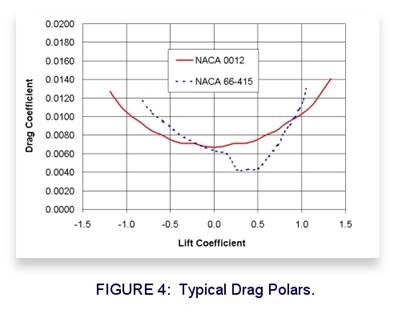
thing to note; we read the drag coefficient information from a different chart
called a Drag
Polar.
Shown in Figure
4,
the Drag Polar illustrates how the drag coefficient varies as a function of the
lift coefficient.
Here
is the equation for drag:
DRAG = Cd * (0.5) * DENSITY *
SPEED * SPEED * AREA
Recall
that the Angle-of-Attack is 5 degrees and the lift coefficient is 0.55. Since
we know the value of the lift coefficient, we can use the Drag Polar chart
shown in Figure 4 to look up the drag coefficient which has a value of roughly
0.0075. Drag coefficients are always shown with four decimal places. When we talk
about Drag Coefficients, we consider the ten-thousandths place to be a
single Drag Count. For example,
the NACA 0012 airfoil shown in Figure 4 has a drag coefficient of seventy-five Drag Counts at the
same time that the lift coefficient is 0.55.
Estimating
the drag force on our wall-to-wall wing-section model is fairly straight
forward. Here is the calculation:
DRAG = Cd * (0.5) * DENSITY * SPEED * SPEED * AREA
DRAG = 0.0075 * (0.5) * 0.002315 * 100
* 100 * 6 = 0.5 pounds.
If
we have a real wing which is not infinitely long, we must modify the 2Ddrag coefficient with an
additional "3D" term, as shown here:
Cd_3D = Cd_2D + [ Cl * 0.5 / (Pi * e *
ASPECT_RATIO)
Cl is
the lift coefficient, Pi is 3.14, e is the Oswald Efficiency Factor (use 0.8)
and the ASPECT_RATIO is the wingspan divided by average chord length.
PITCHING MOMENT
What
about the pitching
moment coefficient?
The moment is often forgotten by many introductory texts even though it is very
important especially for trim drag. For those not familiar with the word
“moment”, that is the engineering term for the common word torque.
Remember: Moment is a fancy word for torque.
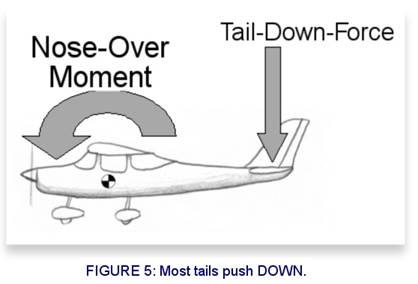
As
a wing flies through the air producing lift, it also has a tendency to create a
nose-over moment or torque. In other words, the airfoil wants to flip end over
end; often called nosing-over. This is not a desired effect. Some airfoils
produce a very strong negative (nose-down) moment and some do not. Most tails
push down to counteract the airplanes desire to flip nose over (See Figure 5
below).
History
has shown that the (pitching) moment coefficient stays relatively constant when
measured about the 25% wing chord position. Because of this, almost all data
about airfoil pitching moments are referenced to the 25% chord position.
Engineers call this the “Quarter Chord” location. The equation for moment is similar to
the lift and drag equations, but it has the actual chord length thrown into it:
PITCHING MOMENT = Cm * (0.5) * DENSITY * SPEED * SPEED * AREA *
CHORD
When
a pilot lowers his flaps, both the lift and pitching moment increase greatly;
the nose-over-tendency is often amplified.
“If
that’s true,” I’m often asked, “then why does the nose on my Cessna pitch
upward when I drop the flaps?”
This
strange effect is caused by two things that happen when we lower the flaps on a
high-wing Cessna. The nose-over pitching moment increases greatly, but the
flapped wing is also deflecting the trailing air at a much more downward angle.
The downward flow of air behind the wing is hitting the horizontal stabilizer
at a much steeper angle; an "artificial" angle of sorts. This results
in a strong downward lift coefficient on the tail, which essentially pushes the
horizontal stabilizer down harder than the wing wants to flip nose down. That’s
why the nose pitches up when we drop the flaps on some high wing
aircraft.
In
Part 4 of this primer series, we will discuss Reynolds Number and laminar flow
airfoils.
PART 4:
OZZY
REYNOLDS AND HIS NUMBER
You
wouldn't give an adult-sized dose of medicine to a baby because the volume is
not scaled correctly for their size. A similar thing happens with aerodynamic coefficients. Just because
you obtained the coefficients from a small model in a wind tunnel test does not
mean they automatically apply to a full-scale aircraft. To ensure that the data
obtained from a wind tunnel is applicable to a full-scale aircraft, all we need
to do is match Reynolds
Numbers.
To better explain this concept, let’s go to the aerodynamics laboratory.
We’re
now standing next to a wind tunnel. Inside, there's a quarter-scale model of an
airplane mounted on a force-measuring device. Let’s call this airplane the Wessna Worrier. The wind tunnel speedometer shows me that
the air inside the wind tunnel is traveling at almost 160 miles per hour. I’m
just a mediocre pilot, but even I know this airplane could never go that
fast. So I ask the operator about this speed discrepancy and he says, “Oh, we’re just trying to match the Reynolds Number to full scale.”
Huh?
The
world of engineering is filled with special numbers named after people long
gone whom you and I will never meet. One of these people was Osborne Reynolds, an Englishman
from the late 1800’s. Mr. Reynolds was obsessed with watching colored dye flow
through pipes. He was especially interested in how the dye would start out
flowing as a smooth streak (Laminar)
and invariably break down into eddy-filled craziness (Turbulent). The same phenomenon
can be seen with cigarette smoke rising from an ashtray. Reynolds didn’t know
it immediately, but he was really studying the concept of boundary layer growth; a subject that
is of paramount importance in aerodynamics. In the absence of boundary layer
phenomena, aerodynamics is downright simple. Unfortunately, major things like
top-speed and maximum lift are very dependent on boundary layers.
At
the beginning of the 20th century, a German researcher named Ludwig Prandtl formulated the equations needed to describe how
boundary layers grew. In short, they get thicker and messier as they progress
downstream. Prandtl used a subset of the previously
known Navier-Stokes equations for his methodology. Very
complicated stuff, but Prandtl was a very smart guy.
The
thing to know is that the Reynolds Number (Re) contains a summary of flow information. It conveys
nearly everything you need to know about a certain flow condition and it
doesn’t even have any units. No feet. No inches. No pounds.
Nothing. It is a product of the fluid density, fluid
velocity, important (characteristic) length, and the reciprocal of the fluids’
viscosity. Think of it as a meat grinder where you pour all the environmental
flow conditions in one end and the unitless Reynolds Number plops out
the other end.
In
essence, when you match the model Reynolds Number with the full-scale Reynolds Number, you are
effectively removing the scale effect.
THE SIZE OF YOUR REYNOLDS NUMBER
With
a little experience, you can get useful information about a fluid flow just
from knowing the magnitude of
the Reynolds Number. For example,
if you see wind tunnel data taken at Reynolds Numbers of 200,000 or less, it is
safe to assume that those airfoils were meant for either model airplanes or
high-altitude airplanes; both conditions lead to small Reynolds Numbers. If the
data was taken with Reynolds Numbers between about 500K and 6million, it
usually applies to general aviation; this is the regime where a lot of
historical and freely available wind tunnel data was taken. When the Reynolds
Number goes above about 9million, we’re usually talking about fighter jets or
passenger airliners. Of course, this is just a rule of thumb and subject to
debate.
HOW TO CALCULATE THE REYNOLDS NUMBER:
1. Find out what your velocity is in
feet per second. To do this, multiply MPH by 1.4667 or you can multiply KNOTS
by 1.689.
2. Find out what your air density is.
Remember that this changes with altitude and it must
be in slugs per cubic foot. You can use the WingCrafter
module in DesignFOIL to find the air density at
altitude. For simplicity, 0.002377 slugs per cubic foot is
used for a sea level density.
3. Find out the viscosity of air. Use
0.00000037373 (it’s a REALLY small number)
4. Decide what the important dimension
is. For wing-sections, that dimension is the chord length. For round objects
like spheres, the dimension is the diameter.
Using
the above information, use this equation:
REYNOLDS NUMBER = DENSITY * SPEED * DIMENSION / VISCOSITY
The
equation is very telling - the numerator (top portion) is made up of momentum
effects and the denominator (bottom portion) is made up of viscosity effects.
As a Reynolds Number grows larger, it implies that the momentum effects of the
fluid are becoming more important that the viscosity effects.
If
you’d rather avoid the above math, here’s a simplified formula for sea level Reynolds
Number using mph and feet:
REYNOLDS NUMBER = 9360 * SPEED(in mph)
* DIMENSION (in feet)
The
mention of Reynolds Number implies "the
appropriate use of a given set of wind tunnel data." It’s easy
to think that any coefficient data that you get from a wind tunnel applies to
the full-scale airplane at the same speed. As we've learned, though, the coefficient
data is only “good” for the Reynolds Number that it was taken at. So, to get
full-scale Reynolds Number data from a wind tunnel, you have to increase the
airspeed over the model in an effort to match what would be the Reynolds number
on a full scale model.
For
example, to obtain aerodynamic coefficient data ( Cl,
Cd, Cm ) from a half-scalemodel that is applicable to the full-scale aircraft,
we would have to double
the airspeedover the model in an effort to equate the
Reynolds Numbers. Or we could double our air density instead, but that is very
expensive and difficult to do. So in summary, if we cut the wing chord in half,
the Reynolds number also gets cut in half. To compensate, we’d have to double
the airspeed to keep the same Reynolds Number. It can be very confusing
sometimes.
Reynolds Number Anecdote (It's true!)
A
friend of mine once tested an Estes model rocket in a
slow wind tunnel. Because the actual rocket was so small and our wind tunnel so
slow, he instead built a giant "model" of the rocket that was ten times LARGER than the
real rocket. At that scale, he could slow the airspeed in the wind tunnel to
one-tenth the speed that the rocket really flies at; this method gave him identical Reynolds
Numbers. Therefore, he could apply the Cl and Cd values that he got from the
wind tunnel directly to his flight performance estimates, even though the model
size was very different.
A TECHNIQUE FOR REDUCING DRAG
Stories
come and go about the legendary airfoils on the WWII era P51 Mustang. It is often
said that the airplane’s high speed was a result of its so-called “laminar
flow” airfoils which you are about to learn about. While it is true that the
wing drag was probably less than contemporary aircraft of the time, the metal construction at the time
prevented those airfoils from reaching their full potential regarding drag
reduction. One of the larger contributors to the extreme speed was probably the
enormous power from the Merlin engine.
Methodically-developed
laminar flow airfoils have been around since even before WWII; they were the
brain child of Eastman
Jacobs,
an engineer at the NACA during the 1930’s. In the preceding 30 years, smart
people like Germany's Ludwig Prandtl learned that
drag could be reduced by controlling the shape and growth-rate of the layer of
thin fluid just above the wing surface. This region of fluid became known as theboundary layer because it
was the boundary between
the wing surface (airspeed = zero) and the outside freestream (airspeed = not
zero).
For
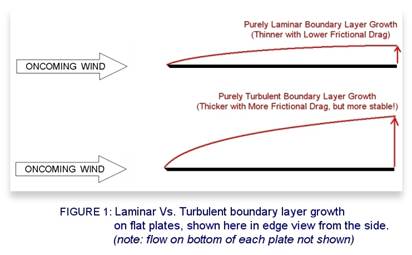
the following explanation, refer to Figure 1 which shows the two common types
of boundary layer growth on a flat plate.
The viscosity of air, or
its' "gooeyness", plays a very important role in the thin region of
air just above the surface of any moving object. On a microscopic level, even
the most polished surface still looks like a mountain range. Air molecules that
try to maneuver these peaks often get stuck and donate their momentum to the
mountains themselves (i.e. the wing) in the form of heat and friction. Just prior to
being halted by the surface of the wing, these molecules of air had been moving
at the speed of the aircraft. The speed changes from full aircraft speed to
zero over a tiny distance.
On
a larger scale this effect is felt as a friction force tugging on the wing
surface (i.e. drag). Again, the velocity of the air in direct contact with the
wing is zero. As we move away from the surface, the speed of the air
accelerates quickly to match that of the freestream flow. Because this extreme
acceleration takes place over a height of just a few millimeters, the viscosity
of air is very important.
A
good way to picture this is to envision traffic on a seven-lane freeway in Los
Angeles. The far-right lane is where cars are entering and leaving the traffic
flow. They are moving slowly and may even be stopped. As you change
lanes away from the slow lane, the traffic moves faster and faster until you
reach the fast lane where the car velocities are highest, hardly affected by
the slow lanes at all.
At
first, the velocity-change between the bottom and top of the boundary layer is
done smoothly and produces a small amount of friction drag on the airfoil. The
layers of air in the boundary layer flow smoothly over one another without any
swirling. This type of boundary layer is called Laminar and
produces very little friction. Think of it as a stack of highly polished playing cards being
dragged over carpet. The cards glide effortlessly over each other while the
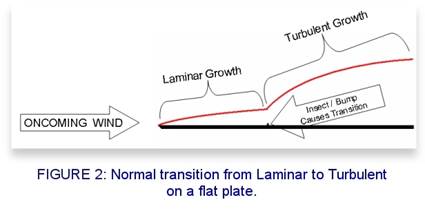
bottom cards are left behind. The trade-off is that this low-friction laminar
boundary layer is not very stable and will switch to a draggier, yet more
stable, turbulent boundary layer at the slightest hint of a surface
imperfection which trips the
laminar flow. And in the real world, the boundary layer usually starts out
laminar and transitions
to turbulent as
shown in Figure 2 below.
The
boundary layer growth on an airfoil is more complicated than a flat plate. The
difference, shown in Figure 3,
is in what causes transition to occur. Imperfections will still trip the
laminar boundary layer, but airfoils have the additional phenomenon of the pressure gradient. The pressure
gradient refers to how the pressure is changing as we march downstream from the
nose of the airfoil. If the pressure gradient is negative, we feel like we are
being swept along faster and faster (like a canoe being pulled toward a
waterfall). When the pressure gradient is positive, we feel higher and higher
pressure and a certain feeling of "pushback" from the air as we march
downstream (like that same canoe going from a high-speed river into a calm
lake).
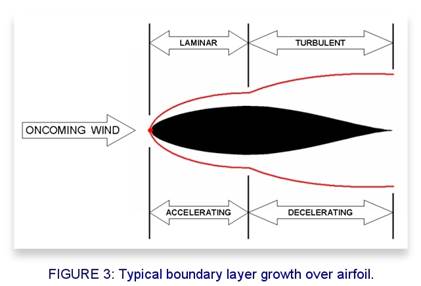
On
the forward portion of an airfoil, the pressure gradient is negative and the
air is accelerating downstream; a perfect habitat for a laminar boundary layer. However, when the
air stops accelerating and begins decelerating, we get a positive pressure
gradient. That causes the laminar boundary layer to transition to a turbulent
boundary layer. The flow loses its smoothness and starts
filling with eddies, causing the outside air to start mixing with the
already formed boundary layer. This “turbulent” portion of the boundary layer is
thicker and produces relatively higher friction drag compared to the smooth
laminar portion of the boundary layer.
The
following list of steps outlines the general birth and death of a boundary
layer on an airfoil:
1. The oncoming air slams into the
leading edge and stops. This point (shown as a red dot in Figure 3)
is called the Stagnation Point. This location serves as a dividing
line. The air beneath goes below the airfoil. The air
above the Stagnation Point goes over the top of the airfoil.
2. As the airflow leaves the
Stagnation Point, it accelerates past both the upper and lower surfaces due to
the strong negative pressure gradient. This unique flow forms a laminar boundary
layer. It continues to grow in a laminar fashion until the minimum pressure
(max velocity) is reached. Unless previously tripped by a surface imperfection,
this is the likely transition point.
3. After transition, the boundary
layer becomes turbulent, eventually leaving the airfoil at the trailing edge.
There
are a few known variants to this script. If the flow condition is at a very low
Reynolds Number, the laminar boundary layer sometimes skips the
transition-to-turbulent phase and instead separates, never to be heard from
again! Sometimes it immediately reconnects forming a thicker turbulent boundary
layer than normal. The region between the laminar separation and the turbulent
re-connection looks like a bubble and is often called a Laminar Bubble. If the laminar
bubble fails to re-establish a viable turbulent boundary layer, the air just
leaves the airfoil at that point and the wing flies around in a semi-stalled
condition.
If
you've done any radio-controlled airplane
flying, you may have seen airplanes with zig-zag tape on the upper surface of
the wing. The purpose of such a boundary layer tripping device is to combat the
laminar bubble problem that occurs at model flight scales. Those pilots are
taking matters into their own hands and forcing that sensitive laminar boundary
layer flow to trip itself into a more stable turbulent boundary layer (to avoid
separation). After all, a draggy turbulent layer is better than separation and
stall.
Using
trip devices (trip strips, vortex generators, etc...) can force an otherwise
laminar bubble to stay attached to the wing long past it's
normal stall angle - turbulent boundary layers tend to be "stickier"
than laminar boundary layers. Some academic cargo-payload competitions can benefit
from this effect by flying at higher Angles-of-Attack, thus carrying more
weight than just a clean wing.
Keep
in mind that the boundary layer thicknesses depicted in Figure 3 are greatlyexaggerated. Here is what
you can expect in the real world: say you are flying along at 100knots at sea
level staring at the pretty sailboats. Your airplane's wing has a 5-foot
(152cm) chord. The airfoil design consistently produces laminar airflow over
the first 20% of the surface, with the rest being turbulent. The laminar
boundary layer thickness would be about 0.060" (1.5mm). The turbulent boundary layer thickness could grow
from 3/8" to 1/2" (9.5-13mm) at the trailing edge of the wing.
Over
the years, we have discovered that creating and maintaining laminar boundary
layers is much trickier in real life. Unlike the mirror finishes of wind tunnel models, real airplanes
are very dirty. Have you ever seen the leading edge of a wing from a full-scale
airplane? It is coated with insect guts - laminar flows don't like insect guts.
In
Part 5 of this primer series, we will discuss laminar flow airfoils in detail.
Chapter 5
LAMINAR FLOW, BY ACCIDENT
During
the 1930’s a self-taught aerodynamicist named David R. Davis went to the trouble
of patenting an airfoil design, which he called the “Fluid Foil” (US Patent
#1,942,688). He considered his design special because it exhibited lower drag
than most other common airfoils, but he wasn’t sure why. His timing was impeccable
because fortunately for Mr. Davis, the Consolidated Aircraft Company was
looking for a marketing trick to make their new aircraft stand out from the
competition; a unique low-drag wing was just the ticket. After verifying the
low-drag performance of the Fluid Foil in a wind tunnel, Consolidated licensed
the airfoil patent from Mr. Davis in 1937. The Fluid Foil eventually found its
way into the wing design of the B-24 Liberator bomber during WW2. (Ref: Vincenti, 1990)
Without
knowing it, Mr. Davis had inadvertently invented the first airfoil to achieve
low-drag through encouragement of a laminar boundary layer, the rarely seen smooth airflow
that briefly exists before the higher-drag, turbulent boundary layer takes
over. The concept of the laminar boundary layer was discussed in detail in Part
4 of this airfoil primer series.
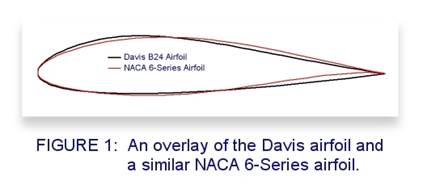
Consolidated
Aircraft went on to build over 19,000 of the B-24 bombers, putting it ahead of
the venerable B-17 in production count. Although many people consider the P-51
Mustang to be the first aircraft to use laminar flow airfoils, the truth is
that the B-24 was the first, albeit accidental, aircraft to use laminar flow airfoils.
The true significance of the P-51 wing was that it was the first to intentionally use the
new scientifically developed NACA 6-series laminar flow airfoils.
As
interesting as these historic facts are, it’s even more amazing to learn that
neither of these airfoils actually produced much usable laminar flow when
finally integrated on real world aircraft. In fact, they were probably just as
turbulent as every other plain vanilla airfoil out there. We can forgive the
designers though - it's one thing to base all of their
data on finely polished wind tunnel models and it's another thing to build real
wings out of sheet metal, rivets, bucking bars, hammers... all with a war
raging against them. Add mosquito guts onto the leading edges and they had
little chance of establishing much of a laminar boundary layer at all.
I
don’t mean to downplay the development of laminar flow airfoils on metal
aircraft. Analytically, it was a significant leap for the early engineers to
"backward-solve" the formulas used for analyzing airfoils. Rather
than starting with known surface coordinates and calculating the resulting
pressure distribution, the NACA personnel figured out how to take the desired pressure distribution and back
out the required surface contours!
Due
to modern day construction methods, stiff composite materials, and improved
laminar flow airfoil designs, there is renewed interest in the use of laminar
flow airfoils in general aviation. Most modern racing aircraft (such as the decambered NASA NLF used on Nemesis NXT) use some type
of laminar flow airfoil; often modified for proprietary purposes.
Laminar Or Not?
It
may surprise you to learn that all airfoils have some laminar
flow; even the airfoil used on the Wright Flyer. Granted, the laminar flow on the
Wright Brothers airplane only lasted a few percent of the chord length, but
there was some laminar flow. This brings up the question of how to classify
airfoils. Laminar or not laminar? As it turns out, the
answer is subjective.
Generally
speaking, for an airfoil to be considered a laminar flow airfoil, it must have
a favorable pressure gradient that extends past 30% of the chord length.
Laminar boundary layers are sensitive beasts and prefer to have the surface pressurecontinuously dropping as they
march downstream from the leading edge. When the surface pressure stops
dropping and begins to increase instead, the smooth laminar flow becomes
turbulent, fighting its way to the trailing edge. It’s easier to fall down a hill
than walk back up it again.
Figure
2 (below) shows a series of very common airfoils and how much of their chord
length will experience favorable pressure gradients (i.e. laminar boundary
layers) under ideal conditions. It is important to understand that extensive
laminar flow is usually only experienced over a very small range of angles-of-attack,
on the order of 4 to 6 degrees. Once you break out of that optimal angle range,
the drag can increase by as much as 40% depending on the airfoil.
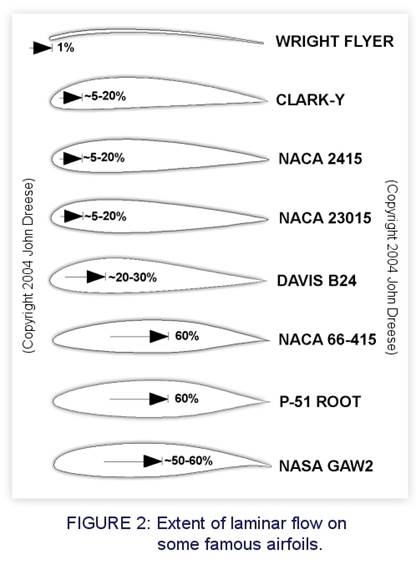
Look
closely at the airfoils in Figure 2. The laminar designs in the lower half
exhibit extensive laminar flow (past 50%). They generally have sharper noses
which can result in a more unpredictable and sharp stall. However, the most
obvious trait is therearward placement of the maximum
thickness.
If you look at a wing edge-on and notice that the maximum thickness is far
back, you can bet that the airfoil is a laminar flow airfoil. I recommend that
you look at a Piper
Tomahawk wing
edge-on; you’ll discover right away that it uses a GAW airfoil.
The Quest for Low Drag
To
understand the great advantages of laminar flow airfoils, we need an
experiment. Imagine that we point a sheet of plywood into a 70 mph air stream
with no angle between the chord length and the relative wind (zero degrees angle of attack). If we could
magically force the boundary layer to stay 100 percent laminar from leading
edge to trailing edge, the frictional drag force would be roughly 0.6 pounds
(0.3 Kg). Now, if we flipped a switch to make the boundary layer completely
turbulent, the frictional drag force would jump to almost 3 pounds (1.4 Kg), a
net rise in drag of nearly 500 percent!
As
we can see from our simple plywood airfoil example, laminar boundary layers
result in much less wing surface friction compared to a turbulent boundary
layer. Remember that real world wings have a mixture of laminar and turbulent
boundary layers so the actual gains are on the order of 40 to 50 percent. The
ultimate goal of a laminar flow airfoil is one where we try to maximize the
laminar boundary layer while minimizing the turbulent boundary layer without
making the whole thing too overly sensitive to surface finish.
Consider
the builder’s ability to control the wing contour during construction and
flight. The surfaces of metal airplanes tend to “oilcan” during flight and this
can change the contour enough to trip the laminar boundary layer.
When
using composites, it’s important to keep close tolerances on the airfoil
contour. Contour control of a surface isn’t just a step-height allowance; it
depends on the chord length that it occurs over. Aluminum?
That's a tough challenge.
Speaking
of surface finish, I’ve heard stories of sailplane flyers actually scuffing the
gloss off their wings in a chord-wise direction from leading edge to trailing
edge with 600-grit sandpaper. If roughing up a surface reduces drag, that
typically means that the boundary layer was blowing off prematurely or had
laminar bubble issues; roughing up the surface helps both of those
situations (in some ways, it is similar to why dimples reduce drag on a golf
ball). Those problems are usually only experienced at very low Reynolds Numbers
(small chord wings flying at either slow speeds or high altitudes).
Anecdotal
stories of Indy race car guys rubbing baby powder on their cars to make it more
“slippery” have been circulating in the pits for years. The baby powder may
have felt smoother to their fingertips, but not to the air molecules!
Traditionally, a very smooth, clean, and highly polished surface will always
result in lower drag numbers. Wax it, don’t powder it!
Designing the Perfect Airfoil
You
may be thinking the same thing that NACA engineer Eastman Jacobs thought
back in the 1930’s. Why not design airfoils that only produce laminar boundary layers? That way,
you could have ultra low wing drag. Let’s take a look
at the numbers.
We
can quantify the reduction in drag due to laminar boundary layer development.
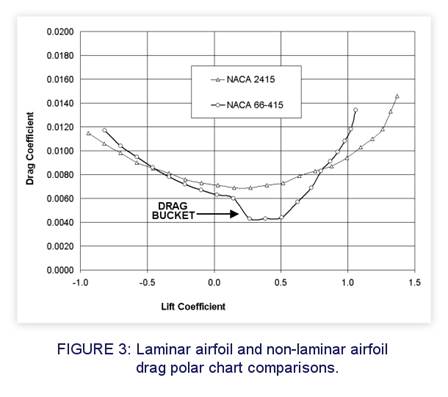
Figure 3 shows the reason why engineers have chased after laminar flow airfoils
for so long. This graph compares the drag polars of two
airfoils. One is for a typical airfoil (NACA 2415) and the other is for a
laminar flow airfoil (66-415). For the latter airfoil, we see that the drag
coefficient drops noticeably between a lift coefficient
of roughly 0.25 and 0.5. Your goal, as a designer, is to make sure that your
desired cruise lift coefficient falls somewhere in that drag bucket. (See arrow
in Figure 3)
Let’s
briefly recall what a boundary layer is from Part #4 of the Airfoil Primer
series. Even the smoothest surface looks like a mountain range when
viewed on a microscopic scale. As air flows past, hugging these surfaces, some
of the molecules get stuck and donate their energy to the microscopic mountains
themselves. These molecules of air that were originally moving with the speed
of the oncoming air flow are halted and brought to zero velocity right at the
surface! In engineering, this is called the “no-slip” condition. On a larger scale this
effect is felt as a friction force tugging at the wing surface.
We
can break it down even further. When the boundary layer begins forming at the
leading edge, it is flowing smoothly with each microscopic layer of air flowing
easily over the next like a deck of waxed playing cards sliding over one
another. This portion of the boundary layer produces very little drag force,
but unfortunately it only lasts until the air racing back along the airfoil
begins to slow down. With non-laminar airfoils, this typically happens within
five to twenty percent of the chord length. At that point, the laminar boundary
layer will begin mixing with outside air and become filled with small eddies.
These so-called turbulent boundary layers can be surprisingly stable, but the
trade-off is they produce higher drag than the laminar boundary layers
do.
Bubble Trouble
Prior
to now, you’ve learned that all laminar boundary layers grow up to become
turbulent boundary layers. When operating at very low Reynolds Numbers (less
than 100,000 for example), this transition to turbulent sometimes does not
occur. The boundary laminar boundary layer encounters the increasing pressure
and occasionally explodes away from the surface, never to be heard from again.
Sometimes it immediately reconnects forming a much thicker turbulent boundary
layer than normal. The region between the laminar separation and the turbulent
re-connection points looks like a bubble and is often called a Laminar Bubble. If the laminar
bubble fails to stay connected, the boundary layer leaves the airfoil at that
point and the wing flies around in a semi-stalled condition. This is very bad.
There have been a few rare cases where airfoils utilizing extreme laminar flow
have been so sensitive that even raindropscaused the boundary
layer to become unstable and blow off the surface, causing a stall.
You
may have seen radio controlled airplanes with zigzag tape on the
upper surface of the wing to combat these low Reynolds Number problems. Those
pilots are taking matters into their own hands and forcing that sensitive
laminar flow to trip itself into a turbulent boundary layer before separating.
After all, a guaranteed turbulent boundary layer is better than a chance of
separation and stall. Some folks have used this trick to get their
radio-controlled airplanes to carry more weight than normal during
cargo-carrying contests (hint, hint).
Luckily,
this tendency to go from laminar directly to separated
occurs less often as the Reynolds number is increased.
Key points to remember about boundary layer development:
1. Laminar boundary layers prefer air
that is accelerating (lowering pressure), but will convert to turbulent the
instant the air begins to slow down. Laminar means LOWER DRAG.
2. Turbulent boundary layers will
form from a laminar boundary layer once the air begins slowing down. Turbulent
means HIGHER DRAG, but not terrible drag. In the case of a golf ball, the
turbulent boundary layer actually reduces drag!
3. At very low Reynolds Numbers, you
may experience the draggy effect of laminar bubbles.
The Final Laminar (Plot) Twist
In
yet another twist regarding laminar flow airfoils on metal aircraft, they
turned out to be excellent performers for high-speed aircraft. High-speed, as in jet-aircraft. And it had nothing to do
with laminar boundary layers; rather it was a function of moving the minimum
pressure location significantly behind the leading edge. This resulted in an
increased critical
Mach number,
which allowed jet-fighters to go a little bit faster by minimizing supersonic
drag over the wings (even a subsonic airplane can experience pockets of
supersonic airflow on top of the wing due to local accelerations).
You
probably don’t have a jet engine though. So how can you make good use of
laminar flow airfoils? First of all, if you’re building a sheet metal wing and
won’t be flying past Mach 0.6 (about 450 mph), then don’t bother with extreme
laminar flow airfoils. Conventional NACA airfoils will work just fine for your
purposes. Van’s
Aircraft has
used the NACA 5-digit series very effectively on their RV models.
However,
if you are building a stiff composite wing, you may want to use a NACA 6-series
or one of the more modern NASA natural laminar flow airfoils. Just be sure to
keep those leading edges clean.
The
next time you visit Oshkosh, Sun-N-Fun, or the Reno Air Races, look at the
wings edge-on and try to guess if they are using a laminar flow airfoil. Ask
the pilot about it; they will appreciate that you noticed.
Congratulations
You've
reached the end of the five-part Airfoil Primer series. Let me know if these
have helped you.
Recommended References:
1. Theory Of
Wing Sections: Including a summary of airfoil data, Abbott and von Doenhoff, Dover Publications, ISBN 0-486-60586-8.
2. The Illustrated Guide To Aerodynamics, Hubert “Skip” Smith, 1985, Tab Books, ISBN
0-8306-2390-6
3. Airfoil Selection, Barnaby Wainfan, self-published and available from EAA.
4. Basic Wing & Airfoil Theory,
Alan Pope, 1951, McGraw-Hill Book Company (does not have ISBN number).
5. History of Aerodynamics, John D.
Anderson Jr., 1998, Cambridge University Press, ISBN 0-521-66955-3
6. What Engineers Know and How They
Know It, Walter Vincenti, 1990, Johns Hopkins
University Press, ISBN 0-8018-4588-2
ABOUT THE AUTHOR
John
Dreese is the creator of the DesignFOIL airfoil
creation and analysis software package, available at:
If
you have any comments or questions, please feel free to email John at:
DesignFOIL@gmail.com
Twitter:
http://www.twitter.com/JJDreese/